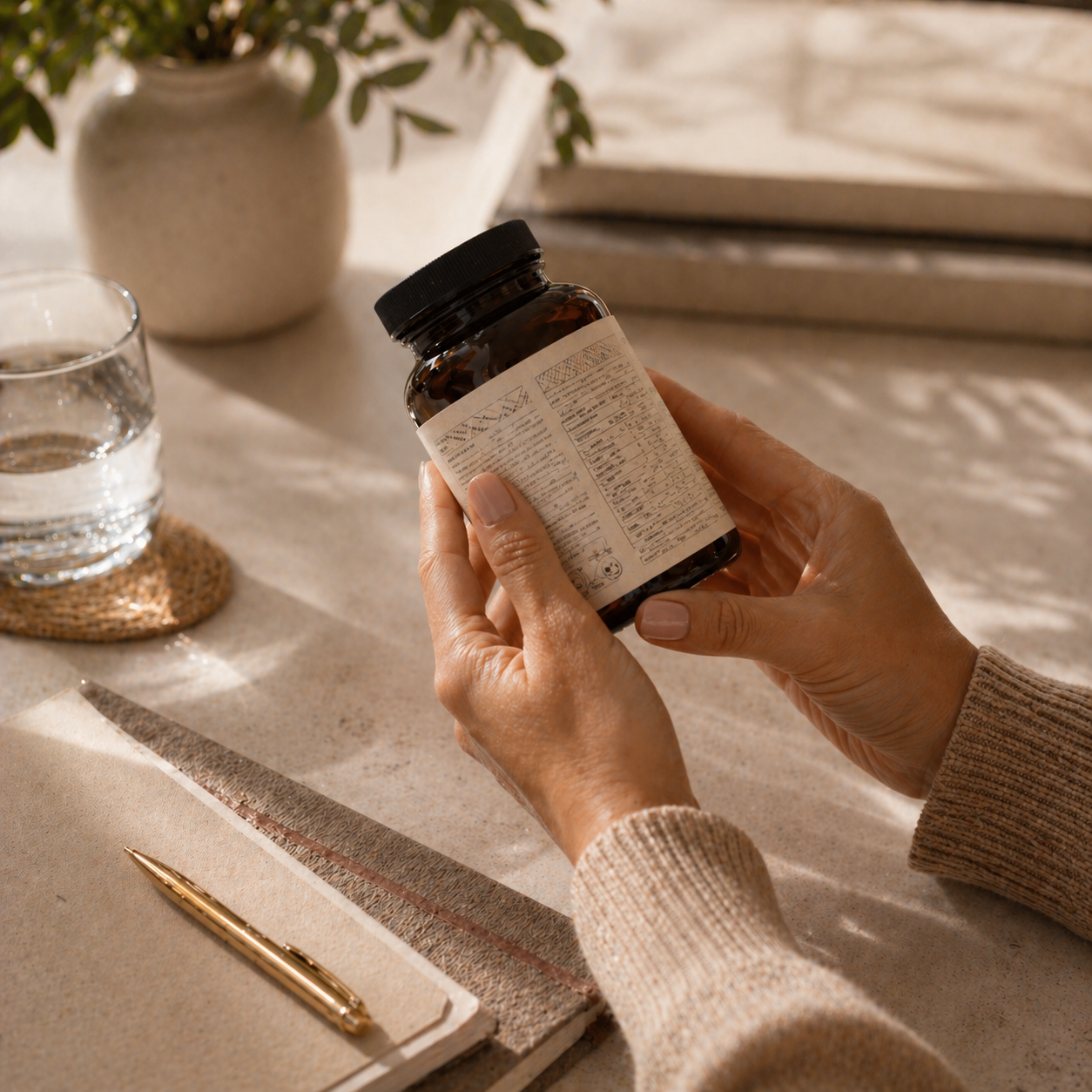
The format in which a supplement is taken is not a design detail: it is part of the formula. The same amount of the same ingredient can have very different efficacy depending on how it is presented to the digestive system. In nutricosmetic supplementation, where continuity and bioavailability are the two factors that most determine the outcome, the format deserves serious analysis.
How a supplement is absorbed: the journey from the mouth to the cell
For an active ingredient to reach its target site—in the case of collagen, dermal fibroblasts—it must go through several stages: disintegration of the dosage form (if applicable), dissolution in the aqueous medium of the digestive tract, stability in the acidic gastric pH, absorption in the small intestine through the intestinal mucosa, passage into the portal and systemic circulation, and distribution to target tissues.
Each of these stages can be a point of loss. An ingredient that does not dissolve well, degrades in the stomach, or has low intestinal absorption reaches the blood in reduced concentration and the dermis in an even lower concentration. The design of the format can facilitate or hinder each of these stages.
Bioavailability in liquid format vs. capsules: comparative data
Tablets and hard capsules require prior disintegration before the active ingredients can dissolve. Disintegration time varies depending on the system and the individual's gastrointestinal status. Soft gelatin capsules—more commonly used for lipophilic active ingredients—have a better profile but are more limited in the amount of active ingredient they can contain. The liquid format eliminates this stage: the active ingredients are already dissolved and available at the time of intake.
In quantitative terms, a 25 ml vial of LEVIAL concentrates the equivalent active load of between 25 and 30 capsules of the same formula. This is not a marketing argument: it is the direct consequence of the fact that the volume of a standard capsule (500 mg-1 g) drastically limits the amount of active ingredient that can be included per unit.
The excipient problem: what's inside a capsule besides the active ingredient
Capsules and tablets require excipients—anti-caking agents, lubricants, diluents, flow agents—that can occupy a significant portion of the total volume and, in some cases, can interfere with the absorption of active ingredients. Some common excipients such as magnesium stearate or silicon dioxide have no known negative effects at usual doses, but their presence in a product taken daily is a factor worth considering.
Adherence: why format determines consistency
The factor that best predicts the long-term outcome of any supplement is adherence: the probability of taking it continuously for the time necessary for it to work. Any source of friction—measuring powders, taking 6 capsules a day, managing multiple products—reduces adherence. The single-dose liquid format, with direct opening and three-second intake, solves exactly this problem.
The format decision for LEVIAL was not aesthetic or marketing-driven: it was a design decision to maximize the probability that those who start, continue. And in nutricosmetics, as in almost everything that depends on biology, continuity is everything.